Related Courses
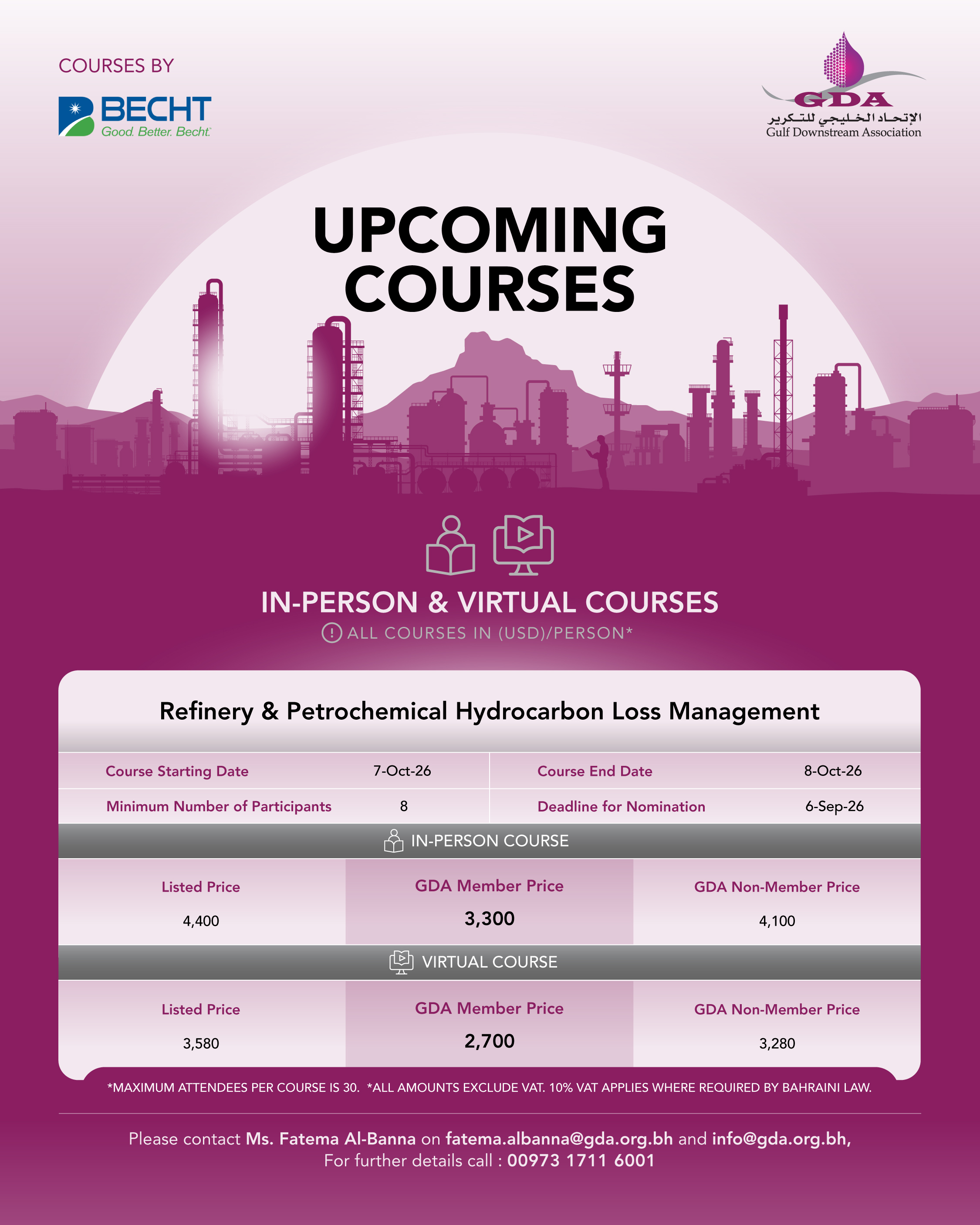
REFINERY AND PETROCHEMICAL HYDROCARBON LOSS MANAGEMENT: IMPROVING PERFORMANCE AND THE BOTTOM LINE
Course Summary:
In oil refineries and petrochemical plants, effective Hydrocarbon Loss Management (HCLM) is essential for optimizing financial, commercial, legal, environmental, and regulatory performance. This course equips participants with a comprehensive understanding of the three core elements of HCLM—Management, Measurement, and Control—and how they function together to improve plant efficiency. Participants will also gain insights into relevant industry standards, hydrocarbon accounting practices, and strategies for identifying and addressing hydrocarbon losses to capture unrealized value.
Course Benefits:
Upon completion of this course, participants will:
§ Understand the importance of hydrocarbon loss management and its impact on facility performance.
§ Learn about the three core elements of a hydrocarbon management system Management, Measurement, and Control.
§ Gain knowledge of industry standards (API, EI) related to hydrocarbon loss management.
§ Develop practical skills to identify hydrocarbon losses, track them, and implement improvements to enhance overall operational performance.
§ Learn how to apply hydrocarbon accounting practices to improve financial outcomes and regulatory compliance.
Course Contents:
1. HCLM Overview:
v What is Hydrocarbon Loss Management (HCLM)?
v Why is HCLM important?
v Identifying potential loss sources in a facility.
2. Management:
v HCLM organization and culture.
v HCLM processes and procedures.
v Understanding HCLM standards (API and EI).
v Setting HCLM goals and objectives.
3. Measurement:
v Layers of HCLM measurement.
v Types of HCLM measurement techniques.
v Considerations for accurate hydrocarbon measurement.
v HCLM measurement standards (API guidelines).
4. Control:
v Effective hydrocarbon accounting practices.
v Hydrocarbon mass balance and reconciliation.
v Identifying and tracking hydrocarbon losses.
v Strategies for improving hydrocarbon loss performance.
Target Audience:
This course is designed for professionals in the refinery and petrochemical industry who are responsible for improving plant performance and managing hydrocarbon losses. Ideal participants include:
§ Plant managers
§ Finance and accounting managers
§ Yield accountants
§ Control engineers
§ Maintenance engineers
§ Plant or process engineers
§ Supervisors in hydrocarbon measurement, movements, and accounting Additionally, professionals from financial and insurance firms, measurement equipment providers, logistics and shipping providers, third-party measurement inspection services, and government agencies will benefit from this course.
Prerequisites:
No formal prerequisites are required for this course. However, participants with a background in refinery operations, hydrocarbon accounting, or plant performance management will find the content particularly useful. Familiarity with industry standards (API, EI) and basic accounting principles will enhance the learning experience.
Instructor:
Jean-Gaël Le Floc'h Jean-Gaël Le Floc'h serves as Manager of Europe Operations with over 25 years of expertise in process consulting within the oil and gas industry, focusing on supply chain, midstream, and downstream refining activities. Fluent in English and French, and proficient in
Spanish and German, Mr. Le Floc’h has built a reputation for delivering technical and strategic solutions to refineries and oil and gas companies worldwide.
Throughout his career, Mr. Le Floc'h has led projects in areas such as refinery configuration, feasibility studies, and margin improvement through energy and yield optimization. He has advised on capital employed optimization, supply chain, logistics, and asset integrity assessments. His work has spanned due diligence for mergers and acquisitions, the development of dynamic simulators for operator training, and the implementation of ISO 9001-2000 quality standards.
In addition to his technical acumen, Jean-Gaël has been actively involved in business development, client prospecting, and managing consultancy projects, with budgets reaching up to €3 million. He has presented at international conferences, contributed to downstream operational excellence communities, and participated in research on advanced hydrocracking technologies.
Mr. Le Floc'h holds a Bachelor's degree in Chemical Engineering and a Master's degree in Refining, Petrochemicals, & Gas from the National Polytechnical Institute of Grenoble (INPG). He is also a member of EVOLEN, the French Association of Petroleum Professionals.